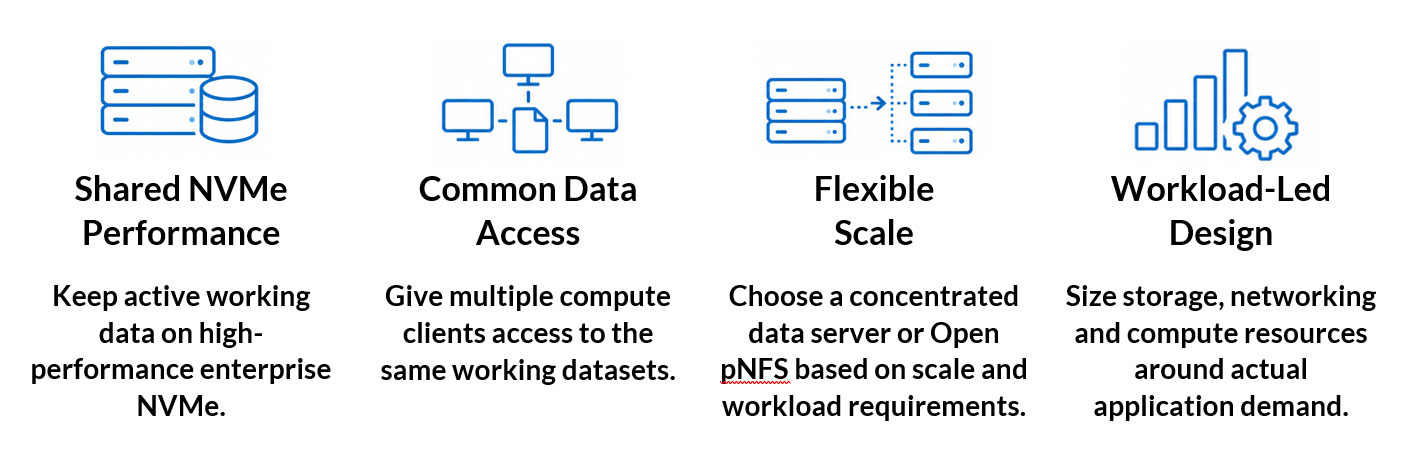
PeakAIO can support a concentrated NVMe performance tier or a larger scale-out architecture. Broadberry matches the platform to your workload and performance requirements.

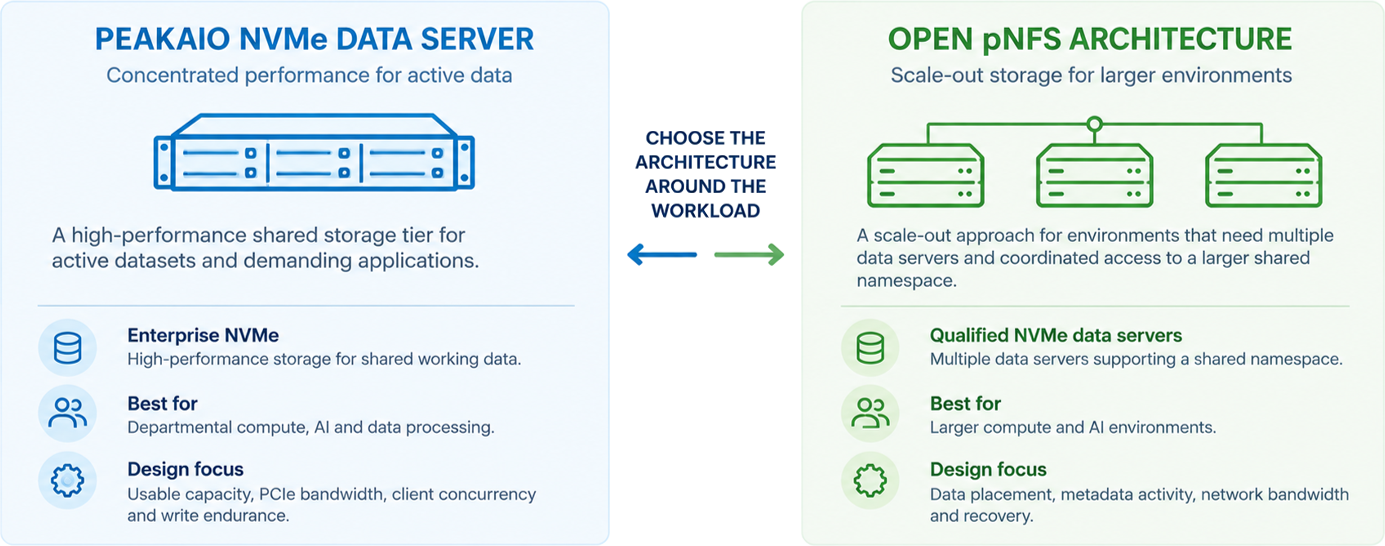
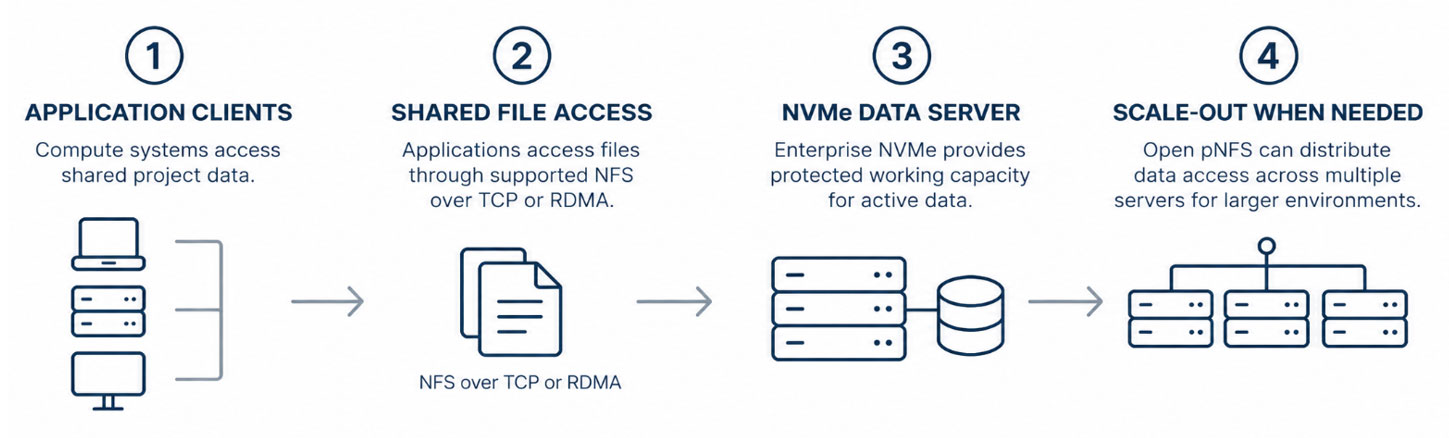
PeakAIO separates high-performance data storage from the services used to organise and access that data. The architecture can range from a single shared NVMe data server to a coordinated scale-out environment.

The result: Fast shared access to active datasets without maintaining separate working copies on every compute node.

| Workload | Typical I/O | Design Priority |
| Scientific Research | Shared inputs, intermediate files and results | Mixed I/O and working capacity |
| Analytics | Repeated scans and temporary outputs | Sustained reads and write headroom |
| Media Processing | Parallel asset reads and output streams | Client concurrency and burst performance |
| AI & Machine Learning | Training reads, model loading and checkpoints | Throughput, latency and protected writes |
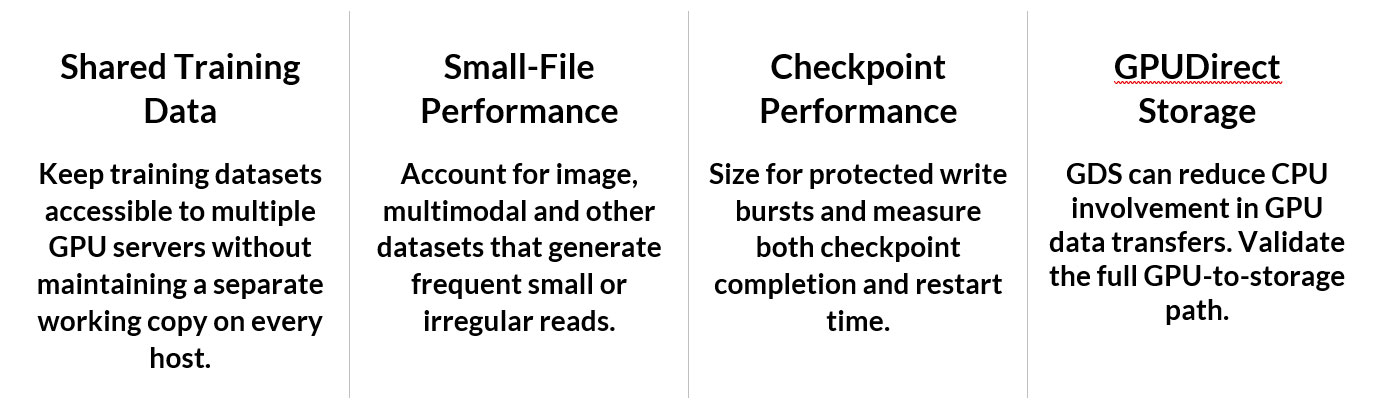
AI storage performance depends on more than GPU count or raw SSD speed. Dataset preparation, training reads, model loading and checkpoint writes can happen concurrently, creating very different demands on the storage platform.


GPU count alone does not determine storage requirements. Broadberry sizes PeakAIO around measured application demand and concurrency.
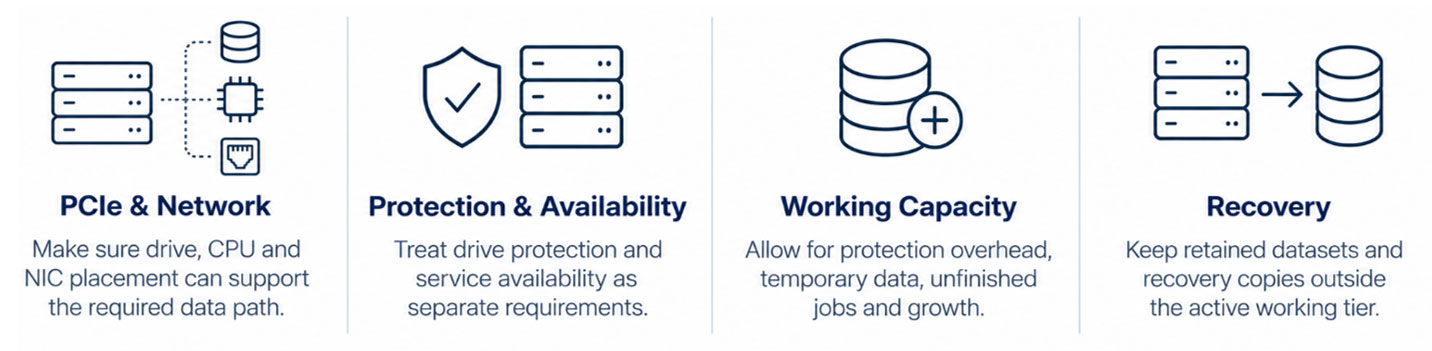
Storage performance depends on more than the drives. Broadberry evaluates the complete data path to identify potential bottlenecks and availability requirements.

Before recommending a PeakAIO architecture, Broadberry evaluates the workload, data path and recovery requirements that determine the complete storage design.
Model active datasets, file
sizes, read/write patterns and
concurrency.
Calculate usable capacity,
protection overhead,
temporary space & growth.
Determine whether a Data
Server or Open pNFS
architecture is a better fit.
Size NVMe, CPU, memory,
PCIe and network resources
together.
Test representative
applications, concurrency
and recovery scenarios.
Plan expansion, upgrades,
maintenance and ongoing
support.

Broadberry brings the storage software and underlying infrastructure together around the requirements of the application.
Start with what the application actually needs to do.
Select supported NVMe, server and network components.
Engineer storage, PCIe, CPU, memory and networking together.
Qualification, validation, expansion and ongoing operational support.
What is PeakAIO storage?
PeakAIO is software-defined storage designed for high-performance shared data access. Its Data Server provides shared NVMe storage, while Open pNFS provides a scale-out architecture for larger environments.
Is PeakAIO only for AI?
No. Although PeakAIO has roots in accelerated computing, it can also be evaluated for data-intensive workloads such as scientific research, analytics and media processing. Application and client requirements should be validated for the proposed configuration.
What's the difference between a PeakAIO Data Server and Open pNFS?
A Data Server provides a concentrated shared NVMe storage service. Open pNFS is a scale-out architecture that coordinates a namespace and directs clients to multiple data servers. Adding independent Data Servers does not automatically create one shared namespace.
Does PeakAIO support high availability?
Availability depends on the selected architecture. Drive protection, redundant network paths and server failover address different failure scenarios, so the required topology and recovery behaviour should be defined and tested for each deployment.
Does PeakAIO support GPUDirect Storage?
PeakAIO can be used in qualified GDS configurations, but GDS requires compatible GPUs, NICs, drivers, storage and an application path that actually uses it. It should be validated with the intended AI workload.
Can PeakAIO replace backup storage?
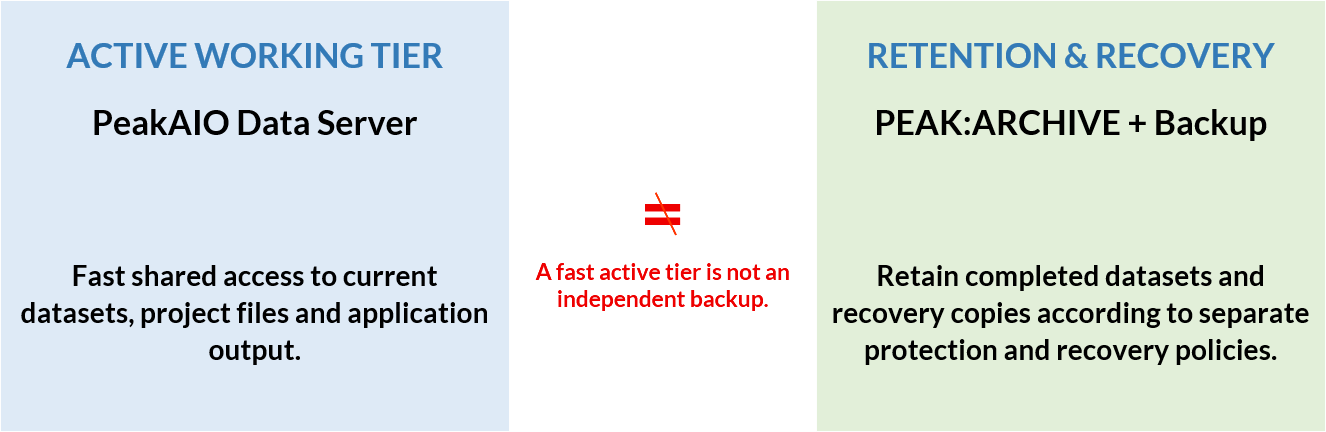
The active PeakAIO Data Server should not be treated as an independent backup. PEAK:ARCHIVE is the relevant PeakAIO product to evaluate for retention, along with the organisation's backup and recovery requirements.
Can PeakAIO scale as requirements grow?
Yes, but adding Data Servers is different from deploying a coordinated Open pNFS environment. Scale-out requirements should account for metadata, file placement, networking, recovery and the supported software release.
How should PeakAIO storage be sized?
Start with active usable capacity, file sizes and counts, read/write behaviour, concurrent clients, temporary output, growth and recovery requirements. For AI, also consider training reads, checkpoint writes, metadata activity and concurrent GPU jobs.
Tell us about your applications, active dataset, concurrency and performance requirements. Broadberry can design the NVMe hardware, networking and PeakAIO architecture around the work your environment needs to support.
Our Rigorous TestingBefore leaving our workshop, all Broadberry server and storage solutions undergo a rigorous 48 hour testing procedure. This, along with the high-quality industry leading components ensures all of our server and storage solutions meet the strictest quality guidelines demanded from us.
Un-Equaled FlexibilityOur main objective is to offer great value, high-quality server and storage solutions, we understand that every company has different requirements and as such are able to offer un-equaled flexibility in designing custom server and storage solutions to meet our clients' needs.
We have established ourselves as one of the biggest storage providers in the UK, and since 1989 supplied our server and storage solutions to the world's biggest brands. Our customers include: